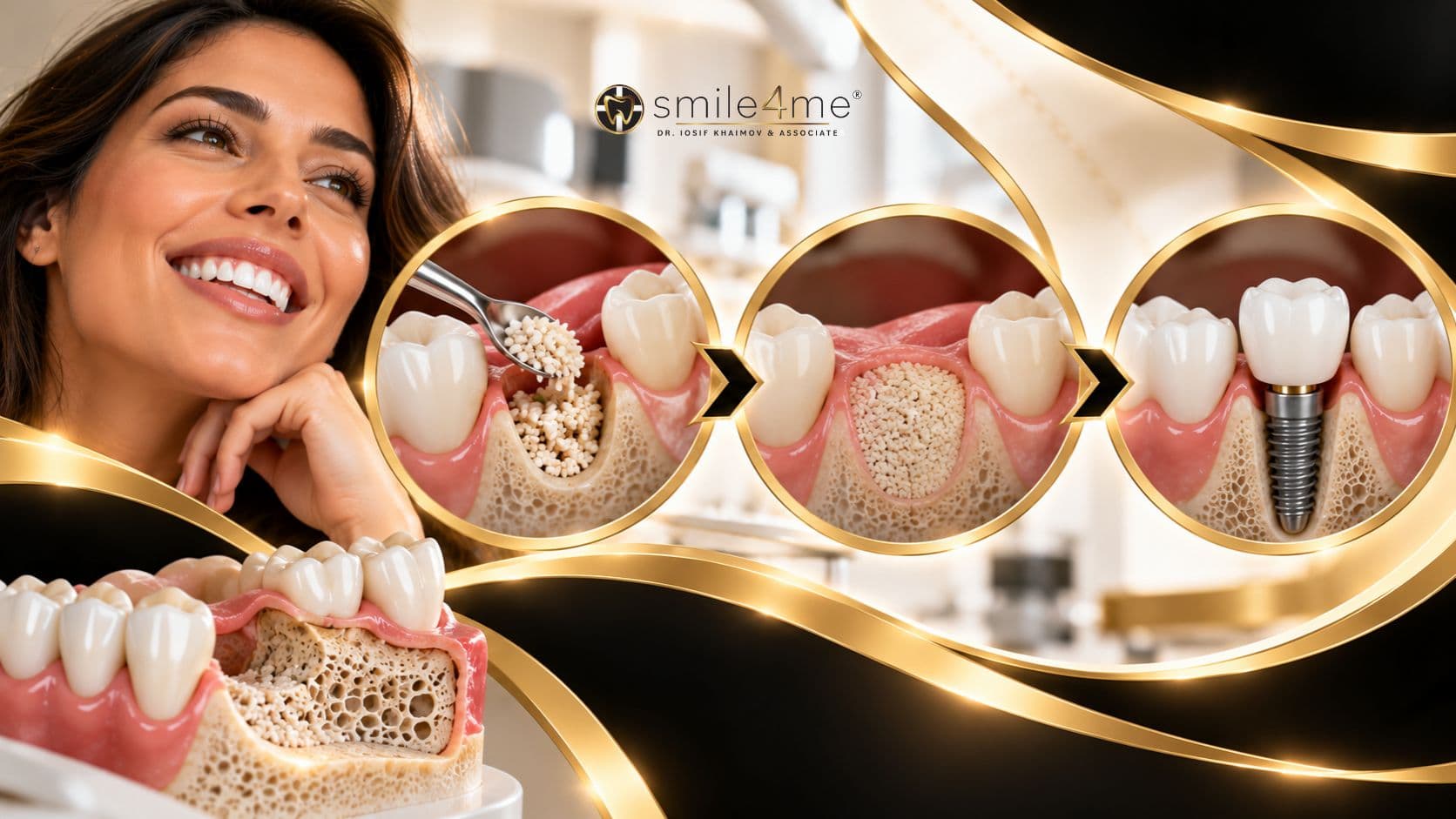
The dental bone graft healing process moves through four stages: swelling and clotting in the first few days, soft tissue closing over by week two, new bone forming over the next few months, and full integration with your jaw anywhere from three to nine months later, depending on the type of graft you had. Knowing what to expect at each stage, and how long your specific graft takes, makes the whole process easier to manage. The healing time depends on the graft and your health, though most patients feel like themselves within a couple of weeks. If pain or swelling ever becomes urgent, our emergency dentist in Astoria at Smile4Me offers same-day care.
What the Dental Bone Graft Healing Process Involves
A dental bone graft adds bone material to an area of the jaw that has lost it. The graft acts as a scaffold, and your body fills in around it with new bone until the two fuse. What began as a temporary filler becomes living bone, solid enough to anchor an implant or steady the teeth beside it.
That new bone is dependable, too. A large national study published through the National Library of Medicine found a 97.83 percent success rate for implants placed after bone grafting, so the months of healing pay off.
A healthy jawbone depends on daily stimulation from your tooth roots. Once a tooth is gone, that stimulation stops, and the bone underneath begins to shrink within months. A graft steps in to preserve or rebuild that structure before the loss makes later treatment harder.
Your dentist may recommend one for a few common reasons.
Tooth loss or extraction: A graft placed in the socket right after the tooth comes out preserves the bone for a future implant.
Advanced gum disease: Periodontitis, a severe form of gum disease, eats away at the bone that anchors your teeth, and grafting rebuilds the foundation the infection destroyed.
Facial trauma: A blow to the jaw can fracture or wear away bone that has to be restored before any implant or crown can follow.
Long-term tooth absence: A gap left unfilled for years lets the ridge slowly collapse, which is why treating it sooner often yields a stronger result.
How Long Healing Takes, by Type of Graft
The type of graft you need affects your timeline more than almost anything else because it determines how much bone is being rebuilt and how much blood supply feeds the site.
Graft Type | What It Rebuilds | Typical Healing Time Before an Implant |
Socket Preservation | Fills the empty socket right after an extraction, before the ridge can collapse | 3 to 4 months |
Ridge Augmentation | Rebuilds width or height in a ridge that's already shrunk | 4 to 6 months |
Sinus Lift | Raises the sinus floor to add bone in the upper back jaw | 6 to 9 months |
Block Graft | Uses a solid piece of bone, often from another site in your own jaw, for major volume loss | 5 to 9 months |
Socket preservation heals fastest because the surrounding bone is already largely intact and well supplied with blood. A sinus lift takes the longest because the graft must mature in a space with less native bone to draw from. Your dentist confirms readiness with imaging rather than a fixed date on the calendar, since healing speed still varies from patient to patient within each category.
Graft Materials and How They Affect Healing Time
The material your dentist chooses directly affects recovery time, since each type is absorbed and replaced by your own bone at its own pace. The right one depends on your case, the size of the site, and how much structure needs rebuilding.
Graft Type | Source | Typical Healing Time | Key Notes |
|---|---|---|---|
Autograft | Your own bone, from the chin, jaw, or hip | 3 to 4 months | Fastest integration, though it requires a second surgical site |
Allograft | Donated human bone, processed and sterilized | 4 to 6 months | Most commonly used, with no second site needed |
Xenograft | Animal-derived bone, usually bovine | 4 to 6 months | Slow resorption helps hold long-term volume |
Alloplast | Synthetic material such as hydroxyapatite | 3 to 6 months | No donor source, and results vary by density |
Location matters too. A graft in the upper jaw near the sinuses tends to take longer than one in the lower jaw, because upper bone is naturally less dense. Your general health, oral hygiene, and whether you smoke all affect how quickly the new bone takes hold.
What Happens While Your Graft Heals

Once the graft is in place, recovery unfolds in clear phases, each with its own milestones. On the surface, you feel better within a couple of weeks. Underneath, your body spends months turning the graft material into solid, living bone that can later anchor a dental implant.
Days 1 to 3: Initial Recovery
Swelling, tenderness, and light bleeding at the site are all normal in the first 72 hours. Keep your head elevated when you rest, apply ice packs in 20-minute intervals, and take any prescribed medication on schedule. Avoid rinsing or spitting forcefully, since a dislodged clot or shifted graft material sets your recovery back.
Weeks 1 to 2: Soft Tissue Healing
By the end of the first week, the swelling starts to fade, and the gum tissue over the graft begins to close and firm up. Most patients move from prescription pain relief to over-the-counter options during this stretch. A short follow-up visit around day 7 to 10 confirms the site is sealing the way it should.
Weeks 3 to 4: New Bone Begins to Form
Now the deeper work starts. Your body begins depositing fresh bone cells into the graft material and using it as a scaffold to build on. This is the most important window of the entire recovery, even though the outside of the site already looks close to normal by week four.
Months 2 to 3: Consolidation
The new bone continues to harden and blend with your natural jaw. Discomfort is usually gone by this point, and most patients are back to an unrestricted diet. Your dentist takes follow-up imaging here to confirm the bone is developing as expected.
Months 4 and Beyond: Full Integration and Implant Readiness
By the window shown in the table above, the graft has typically been replaced by or fused with your own bone. A final cone beam CT scan confirms density and volume before scheduling an implant. Rushing this stage is one of the most avoidable causes of implant failure, so the wait protects your result.
How to Protect the Graft While It Heals

Good aftercare in the early weeks does more for your outcome than almost anything else. A few simple habits keep the site clean, calm, and undisturbed while the graft settles.
Oral Hygiene Around the Graft Site
Avoid brushing directly over the surgical site for at least the first two weeks. Your dentist will usually prescribe a chlorhexidine rinse to reduce bacteria without disturbing the healing tissue. After the first 24 hours, gentle saltwater rinses help keep the area clean between prescribed rinses.
What to Eat, Phase by Phase
For the first week or two, stick to soft, cool, or lukewarm foods like yogurt, scrambled eggs, mashed potatoes, smoothies, and soup. Our list of soft foods to eat after a procedure gives you plenty of options that won't irritate the site. Around weeks three and four, you can add softer solids such as pasta and cooked vegetables, then return to a normal diet once imaging confirms the graft is solid.
Activity Restrictions
Skip strenuous exercise for at least the first week, since a spike in blood pressure can restart bleeding and unsettle the clot. Most patients handle light activity by day five to seven and resume their normal routine within two to three weeks. When in doubt, ease back in rather than pushing through.
What Slows Healing Down
Smoking, uncontrolled diabetes, poor oral hygiene, and infection all raise the risk of a graft that struggles to take, and smoking is the biggest factor by far. A review of implant and graft studies published in the Indian Journal of Dental Research found that implant failure rates in smokers run more than twice that of nonsmokers, and the gap is even wider for implants placed in grafted sinuses. If you smoke, stopping in the weeks around your procedure meaningfully improves your odds, even if quitting for good isn't on the table right now.
Signs of Healthy Healing and When to Call Your Dentist
Most recoveries are quiet and uneventful, and healthy healing has a recognizable look. A few things at the site can seem alarming while being completely normal.
A small crater where the tooth used to be, white or off-white material inside the socket, and even a few tiny granules working loose are all expected, not a sign of infection. That white material is usually healing tissue and early bone forming underneath. Visible sutures are routine as well.
A few symptoms, though, are worth a prompt call to your dentist.
Worsening swelling: Swelling that grows after day three instead of easing.
Fever: A temperature above 101°F.
Discharge or odor: Pus or a foul smell at the site.
Shifted material: Graft material that looks like it has moved out of place.
Escalating pain: Sharp pain that keeps building and doesn't respond to medication.
Why Patients Trust Smile4Me for Bone Grafts in Astoria

At Smile4Me Dental Care, your whole recovery stays under one roof. Dr. Iosif Khaimov, a New York University College of Dentistry graduate with more than seven years of hands-on experience, oversees the grafting, monitoring, and implant placement in-house on Steinway St., so there are no outside referrals and no gaps in your care.
He uses cone beam CT scanning to track graft integration and confirm you're ready before placing the implant. As a trusted dentist in Astoria, Smile4Me also offers flexible financing of up to two years with 0% interest, so you can move forward with care on a timeline that fits your budget.
Book Your Bone Graft Consultation Today
Healing a bone graft takes patience, but the payoff is a stronger jaw and a stable base for lasting restoration. Protecting the site in those early weeks, staying tobacco-free, eating well, and keeping every follow-up appointment are the choices that most shape your outcome.
When you're ready to rebuild your smile on solid ground, book an appointment online with Smile4Me Dental Care in Astoria, or call us at (718) 400-4400 to find out where your recovery stands and what your next step looks like.
FAQs About Dental Bone Grafts
How painful is a bone graft?
The procedure itself is done under local anesthesia, so you feel pressure rather than pain. Afterward, most patients have manageable soreness that prescription relief covers for the first few days, before over-the-counter options take over.
Can a bone graft fail?
It's uncommon, but a graft can fail to integrate, usually from infection, movement of the material, or risk factors like smoking. Your dentist monitors it with follow-up visits and imaging, so they catch problems early.
When can I get an implant after a bone graft?
It depends on the graft type. Socket preservation grafts are often ready in three to four months, ridge augmentation in four to six, and sinus lifts in six to nine. Your dentist confirms readiness with a scan rather than a fixed date.
Will my insurance cover a bone graft?
Coverage varies, and some plans pay toward a graft when it's medically necessary. Either way, Smile4Me offers financing with up to two years of no interest to keep it manageable.